Author, Book Review, Books, Hindu mythology, Indian philosophy, Mythology, philosophy

Things you need to know about the book ‘Ramayana versus Mahabharata: My Playful Comparison’ by Devdutt Pattanaik.

Review of one of the most enlightening Hindu mythological books.

“Myths may not satisfy the demands of rationality or science, but they contain profound wisdom – provided one believes they do and is willing to find out what they communicate.” 

― Devdutt Pattanaik,

https://www.goodreads.com/author/quotes/200940.Devdutt_Pattanaik?page=2

Mythology has always played a pivotal part in civilizations around the world since ages. The prehistoric cave paintings to other tangible monuments have left traces of mythology and this makes it easier for us to access and adhere different religions that prevailed. As Carl Jung, the famous Swiss psychiatrist and psychoanalyst, mentioned, “myth is a necessary aspect of the human psyche which needs to find meaning and order in a world which often presents itself as chaotic and meaningless”, there is significance of mythology even today in our lives, the only need is to interpret it right. Ramayana versus Mahabharata: My Playful Comparison by Devdutt Pattanaik, has some similar lessons to proffer, enhancing the importance of mythology and its relevance in the present times.

Book: Ramayana Versus Mahabharata: My Playful Comparison
Author: Devdutt Pattanaik
Published by: Rupa Publications India Pvt. Ltd, New Delhi
Year of publication: 2018

About the author

Devdutt Pattanaik is a well-known Indian author with expertise in the areas like mythology, ancient Indian scriptures, symbols and rituals and other stories or narratives. His other books include, Myth= Mythia: A Handbook of Hindu Mythology, Jaya: An Illustrated Retelling of the Mahabharata, Shikhandi: And Other Tales They Don’t Tell You, Shiva to Shankara: Giving Form to the Formless and many other that have incorporated Vedic knowledge generously. To get Saraswati out of the closet, as she belongs everywhere and has to flow everywhere and to make knowledge accessible, is his desire and aim. By Saraswati, he means ‘Knowledge’, as the Goddess Saraswati is associated with knowledge, Pattanaik uses the mythical name, while addressing it to everyone.

No society can exist without myth as it creates notions of right and wrong, good and bad, heaven and hell, rights and duties. Mythology tells people how they should see the world..different people will have their own mythology, re-framing old ones or creating new ones.

– Devdutt Pattanaik

https://en.wikipedia.org/wiki/Devdutt_Pattanaik

What makes the book ‘Ramayana versus Mahabharata: My Playful Comparison’ significant?

Time and again, Devdutt Pattanaik, the accomplished author has given some invaluable definitive works on the genre- mythology. Beginning with the external aspects and then to the internal, here are some points that escalates the significance of this particular book.

Distinct title and vibrant colour

Most of Devdutt Pattanaik’s books actually hold a very distinct title, that gives a clear idea about what is going to be inside unlike other ‘do not judge me by the cover‘ kind of books. As his concept revolves around mythology and mythical stories, the distinct nature of the title makes it easy for a reader to choose as to which part of mythology they want to read about. The title Ramayana versus Mahabharta: My Playful Comparison is no different. You know it is a comparative narrative of both epics. The colour of the cover is bright and vibrant red that catches the eye.

smacap_Bright

Striking illustrations

Devdutt Pattanaik’s illustrations speak many stories at once. They are precise and narrate a story in themselves. Every book consist his illustrations. Not only as an author does Pattanaik wins hearts but as an illustrator too. Each chapter has a related illustration which makes it more appealing and enhances your imagination while reading.

Introduction and interpretation of religion or Dharma
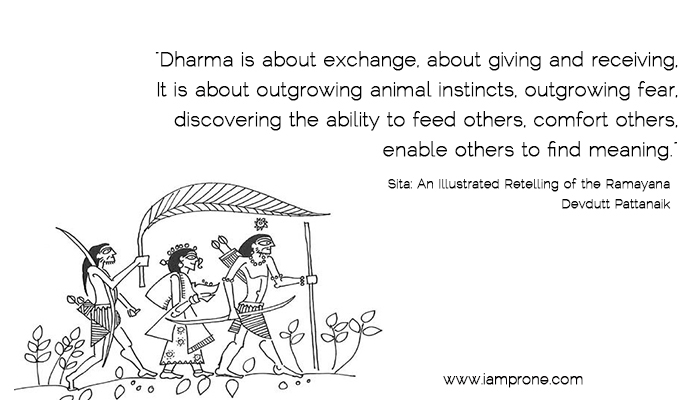
As a reader, you will be introduced to the context on which the book is based on with all possible elaboration of its meaning and real sense. There is no necessity for you to be well-versed in the genre mythology or to have read the original scriptures of the two epics Ramayana and Mahabharata before reading this comparative narrative. The book will suffice your quench of knowledge regarding religion or dharma and this term is often seen in most of the books by Devdutt Pattanaik, a constant reminder of what Dharma or religion is or could be.

Epiphany of perspectives

This book unveils perspectives that will surprise you and leave you thinking, those that you would not have thought about otherwise. It touches upon all the aspects of religion, mainly Hinduism because of the genre and relates it with everyday life, irrespective of the reader being a Hindu. There are inferences of Buddhism, Jainism, and sometimes of Christianity and Islam as well, all that makes much more sense and highlights the commonality and differences with reasons.

Embracing all aspects- Man to Woman to Transgender and many other

https://www.wisefamousquotes.com/devdutt-pattanaik-quotes/

One of the best attributes of Devdutt Pattanaik’s books are that even though each book stipulates one term or concept, yet speak from every side and corner, right from man to woman to transgender, to patriarchy and feminism. Ramayana versus Mahabharata is no different. It holds all the aspects hidden and evident both. If a chapter talks about men one side, there is a chapter dedicated to women and transgender too. This only enhances the importance of the book.

Humanism over theology

Everybody dies- some suddenly, some slowly, some painfully, some peacefully. No one can escape death. The point is to make the most of life -enjoy it, celebrate it, learn from it, make sense of it, share it with fellow human beings so that when death finally comes, it will not be such a terrible thing.” 

― Devdutt Pattanaik

https://www.goodreads.com/author/quotes/200940.Devdutt_Pattanaik

Devdutt Pattanaik constantly emphasizes on humanism through his interpretation of this comparative narrative. In the end, the conclusion you can draw out of all chapters will comprise of ‘what to learn from the? how and what you can relate to? how close this is example is to one of your life experiences? and how you can apply the lessons learnt here to be a good human yourself?’

After a lot of thinking, whether or not to write a review of this book or even after deciding to, what all should be present in this compilation or how much justice will my review do to this brilliant piece of work was my instant thought. It astonishes me as to how much an interpretation or perspective could be this precise, relevant and makes absolute sense in the world, allowing me to think or reason and to apply the lessons learnt through it.

You can find Ramayana versus Mahabharata: My Playful Comparison by Devdutt Pattanaik-

Amazon – https://www.amazon.in/Ramayana-Versus-Mahabharata-Playful-Comparison/dp/9353332303

Kindle edition- https://www.amazon.in/Ramayana-Versus-Mahabharata-Playful-Comparison-ebook/dp/B07KKLJ4SJ/ref=tmm_kin_swatch_0?_encoding=UTF8&qid=&sr=

Flipkart- https://www.flipkart.com/ramayana-versus-mahabharata-my-playful-comparison/p/itmfagerhku45p5w

Rupa Publications (ebook available)- https://rupapublications.co.in/books/ramayana-versus-mahabharata-my-playful-comparison/

Crossword (online) – https://www.crossword.in/nonfiction/ramayana-versus-mahabharata-my-playful-comparison-pattanaik-devd/p-1341200-77733339319-cat.html

Standard
Assam, Crisis, India, Inspirational, life, Motivational, Mysery, Polity

National Resources under Natural Threat

All you need to know about the drowning Gateway of North-east India.

Assam, the Gateway of North-east India, the land of Red river and of the magnificent Blue hills.
The land of largest tea garden and of the fleecy silk ‘Eri’ and ‘Muga’.
The land with men in ‘Suria‘ or ‘Dhoti‘ and women in ‘Mekhela Chador’ or ‘Riha Mekhela’.
The land holding the legacy of Kamarupa and of the Ahoms, whom Assam derives its name from and the land that sees the ‘Bleeding Goddess’ as divine.
The land of “Dig-Boi” producing onshore natural gas and land of national parks dwelling ‘One-horned Rhino‘ along with numerous specie being worshiped the most

Recently, this pleasing land of the undemanding people has seen nature’s wrath but hope and succour of the people is still intact and unaffected. Although, it is not the first time that the State has witnessed something as devastating as this, it has only become more immune and stronger with each calamity’s stroke without any talking about their grievances.

“We have grown up watching the floods. My Grandmother recollects the time when they had lived on streets and the conditions have been this worse since then. It has become a routine for us; like other seasons- summer, winter and rainy, the floods have become a season too.”

– A resident of Assam.

What is happening in Assam?

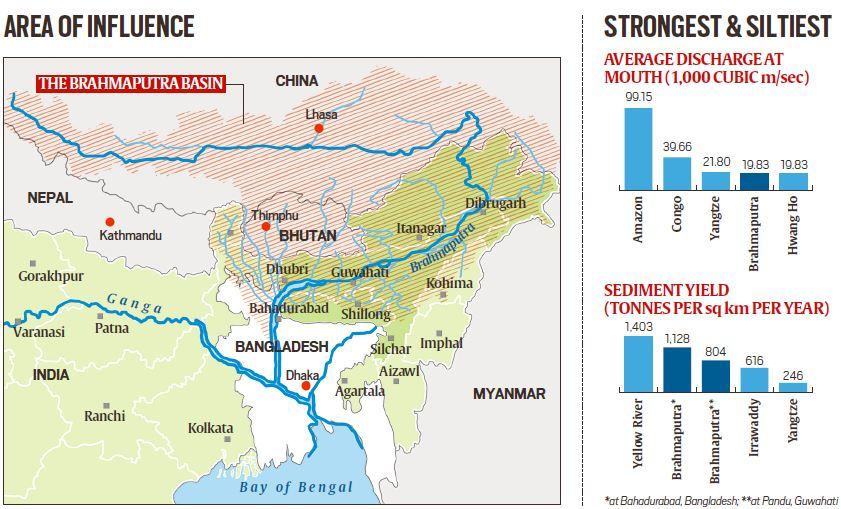
Overflowing of the rivers Brahmaputra, Barak and Jia Bhoreli has left the state into a catastrophe. Brahmaputra floods keep striking the state every now and then, but the sudden rise in the rivers since June 2019 has caused severe damage to the state. Assam receives excessive rainfall as it falls under the meteorological zone causing an increase in the water levels of the Brahmaputra and its tributaries that flows through the state.

Till 18th July, death toll touched 27 and increased, 4000 villages in 28 districts out of 33 of the state have been affected. 1000 houses damaged and over 16 lakh animals included livestock have been affected.

Assam State Disaster Management Authority. https://www.indiatoday.in/india/story/monsoon-misery-assam-annual-tryst-with-floods-1571473-2019-07-20

The Brahmaputra floods are not a new concept. It is a catastrophic flood event occurred across the Brahmaputra and its tributaries subsequently since 2012.

https://en.wikipedia.org/wiki/Brahmaputra_floods

The floods have severely damaged the embankments, roads, bridges, culverts and many other infrastructures of Assam and Barpeta district is the most devastated out of all others, followed by Nagaon, Goalpara, Morigaon and Hailakandi. The rising water level has affected Nematighat, Tezpur, Guwhati, Dhubri, Goalpara. Other areas affected include Dibrugarh, Kamrup, Cachar, Lakhimpur, Golaghat, Sonitpur, and Karimganj. The floods have affected 95% of Kaziranga National Park has with the increase in the toll of wild animals and some submerging in water, including the affects on anti-poaching camps of the national park. The Pobitora Wildlife Sanctuary in Morigaon district was also flooded. Floods in Assam has disastrously hit the agricultural lands too.

Why is Assam prone to floods?

Any area affected by some crisis has contribution of both natural and man-made factors. Assam already falls under the meteorological zone that receives excessive rainfall during monsoon. The region has occasionally witnessed even 500 mm of rainfall in a day.

The region receives rainfall ranging from 248 cm to 635 cm, rainfall of more than 40 mm in an hour is frequent and around 70 mm per hour is also not uncommon.

Brahmaputra Board, Ministry of Jal Shakti.
https://www.indiatoday.in/india/story/monsoon-misery-assam-annual-tryst-with-floods-1571473-2019-07-20

The rapidly overflowing rivers through the narrow valley where the Brahmaputra flows from, spread reaching the narrow strips which later affects the forest covers and farming areas in the low-lying areas around. Assam also possesses steep slopes that results into rivers cascading towards the plains. As the North-east region of India lies in a seismic zone, earthquakes and landslides are frequent which ends up in sedimentation that raises river beds. Other major factor is encroachment- the destruction of natural drainage like wetlands and water bodies has provoked the problem.

What can be or is being done for Assam floods?

Measures have been taken by the locals and the State Government through rescue operations and rehabilitation. People have been evacuated and accommodated to relief camps across the state. Major role being played by the National Disaster Response force and Khalsa Aid that has been distributing emergency supplies to flood-affected people in Assam and other flood affected areas earlier. Similarly, the State health department along with animal husbandry and veterinary are also addressing medical issues due to the floods.

How can you contribute?

Natural calamity is a phenomenon that we cannot control or stop. It will happen and it will stop too, but the amount of destruction it causes is transcendent. All we can do is take measures or precautions to be prepared or at least find ways to recover for the aftermath. As humans, we need to help other humans.

Assam has been suffering for a long time, the State has been recovering on its own and the Centre has taken the matter into consideration, although none have been able to successfully find a solution for the inevitable floods. As fellow countrymen and humans, it is our responsibility to provide aid to the state in all possible ways. An official account and website for relief funds have been spread among others. Below mentioned are the details for the same along with the official website of the Chief Minister of Assam attached, where you can donate.

Account-Holder’s Name: Chief Minister’s Relief Fund Assam
Bank: State Bank of India (SBI)
Account Number: 35969660230 (SBI), Secretariat Branch
IFSC: SBIN0010755
PAN: AAATC4667K

https://cm.assam.gov.in/relieffund.php

Some other ways to help the flood affected people

Paytm app- the mobile payment app can be used for making online monetary contribution to Assam Flood Relief. You can also contribute items like Rice, Dal, Biscuits, Sanitary napkins, clothes and other essentials to the authorities in Assam through mentioned details and link ahead.

Jhalukbari
Name: Debashish Rajkhowa
Address: H-10, Pragjyotish Nagar
Contact Number: 8876993579

Dharapur
Name: Robin Diksha Dhar
Address: Agrim Vista
Contact Number: 7002602010

Narangi Tinali
Name: Robin Ajay
Address: Indira Gandhi Computer Shakshrta Mission, Opposite of UCO Bank
Contact Number: 9085140567

More details in here : https://www.kaziranga-national-park.com/blog/assam-flood-information/

https://www.wti.org.in/tag/kaziranga-national-park/

Standard
Inspirational, Motivational, philosophy, Uncategorized

Six ways to keep yourself happy.

Happiness is not a product or property to be owned. It is a state of mind that can be created.“- The Sapient Musings

https://sapientmusing.home.blog/

Life has come to a point where an emotion, the basic, has to be reminded and motivated about. We are on the search of those emotions that we feel are lost among the hustle and tussle of everyday life. Emotions are present in each one of us. Some inclining on the extreme side, while some on the mild or least side. When I look around the people around me, I think, I introspect, if they are truly happy. I ask myself, if I am happy. The ones reading this right now, ask yourself if you are happy? Happy about the job you do, about the people you are surrounded by, about the things you do, about the life you live? We are still trying to figure that out.

It is true that many of us are lagging behind the fast pacing world unable to cope up with and find a solution for it. This is continuously repressing us from being happy. Here are five ways that you can keep yourself happy.

Know your needs

“After nourishment, shelter and companionship, stories are the thing we need most in the world.” 

― Philip Pullman

https://www.goodreads.com/quotes/tag/needs

A lot of people fail to distinguish between needs and wants, this is one of the major cause of distress. Once you know what is your need and work to suffice it, you will be less distressed. Know what you need, what is your instant need and save the rest for later. This process will satisfy yourself which will unconsciously and consciously make you happy.

Acknowledge and focus on the good

In a day, there are many good things that happen, that usually are ignored or goes unacknowledged by us. Keep a track of the good things that happen with you in a day and count on them. This will help you focus less on the negative and more on the positive side of your day ending up in a happy mood.

Appreciate little things

Start noticing the little things that you come across everyday. It is the little things that embrace big happiness. Notice and appreciate if someone smiles at you, if someone helps you, if someone appreciates your efforts. We may snub these little things, but these are the reasons that can make your day.

Stop the comparison

Remind yourself that you are good the way you are and doing better whatever you are doing! We often compare ourselves and our lives with others, this is a natural phenomenon but consciously you can remind yourself that you are doing good. The comparison is what makes you feel less and leaves you in a desperate state of owning things and a life that someone else owns. Remember, the grass is always greener on the other side. The mantra to be happy is to be happy with what you have and feel happy when others grow.

Achievements are not the only success

Achievement and success are two different things. You many not always need to achieve something to be successful but you can be successful without achieving big things. It is easy to be happy after realizing this. Achievement and success can differ individually too. For some, success might be money, growth, luxury and achieving other big things, while for some it might be just helping out someone in a day, making someone cross the road or show direction, or help in some task. Knowing what success and achieving means for you will help you in being happy.

Yourself, hard-work and time

There is no other mantra for being happy except for yourself, hard-work and time. When you know your needs, your thoughts and ideas, your caliber, your skills and when you incorporate all this with some hard-work and leave it on time, things will fall on its place. Time is a healer and assents with hard-work. This is the ultimate solution to be happy.

Standard