To those who are already aware of this world, to those who are just stepping in and beginning to explore and to those who do not even believe in such a world, this world is more relevant and mystic and we all need it. I have always wanted to infuse or reinfuse belief in people, make them realize how empowered they are already and that it is just a matter of believing in themselves. Believing all the crazy things happening with or around them. I did and I realized I was not alone to experience them.
This world is different from anything we see or are around. Call it a different world, dimension, universe or whatsoever, every bit of it will make sense to you if you are ready to believe, accept and hang on! If you are already in it, hang in there, allow yourself to be touched by magic, synchronicities, patterns and so much more there you wouldn’t comprehend otherwise. The best part about choosing to be in the spiritual world is that it elevates you and empowers you with or without you knowing it. The process is seamless. You would not realize the subtle changes that you go through. These changes turn you into a better soul every passing experience. All this may still seem absurd and not make sense to some people, if it does not, it simply doesn’t and that is true for them- no denial or imposition of ideas. Others who believe or have experience will know what I am talking about.
This podcast is for all those who wish to experience more of this world, for those who are tired of many things in the physical world, for those who have somehow given up on their beliefs. This world does not abandon anybody, it is open for pretty much anybody who is ready to see, listen and experience.
There are some books meant for something beyond the labelled purposes- educate and enlighten. Some books are not just mere pages, words and experiences (all inclusive) but they are MESSAGES meant for you and Conversations With God by Neale Donald Walsch is one such book. This book has three parts of which the first part is what this review-experience is all about. I am more convinced than ever that perfect timings exist, from doing or not doing something to reading a book or coming across a message, things happen on time. I would like to first acknowledge and express my gratitude to Shweta, one of my Instagram friends who introduced this book to me for which I’m eternally grateful. I see her as the God sent ‘Messenger’. Something in her post about this book stayed with me and I decided to read it. This book is what connected me to her and developed this friendship or rather connection that I know is meant to be and it is an honour to experience it. Heartfelt gratitude to the author N. D. Walsch himself who chose to write this book and spread the magic beyond him, on people who desperately need it. I believe this book has reached people at the time destined.
Every so often, you may suddenly find a book that was lying in a corner or amidst the stack for years, and decide to read it all of a sudden, only to find how life-changing it is. Conversations With God has been such a book for me at least. If I have to suggest one book to every person, this would be it. The book talks about almost everything and not just praising or defining God. It is more real and serious than it may even sound. People differ in their interests and choices naturally, some may be intimidated by this book or even find this review vague or ‘crazy’. However different our thoughts may be, in the deepest depth and farthest realm, we are all souls. We all have the potential to feel, think and experience similar, collectively and ‘crazily’. It all may direct to one message, one goal or one truth. Truth is, after all, One- with countless or limitless facets, much like us humans or souls or GOD.
Initial Thoughts
Initially, while reading the book, there was a little conflict within my mind. The book did not seem to resonate with my conditioned idea of God. The whole idea of a book speaking to me in the form of God was weird to me. In all honesty, I even thought that, perhaps, the author wants to create his version of God just so that he can give sense to what he is writing and all this he even did effortlessly and rightfully. I was just a thought away from discontinuing until the thought of – KEEP AN OPEN MIND barged in. First Walsch tries to make us comfortable with this idea that it is God speaking to him or us. He seems to be equally skeptical and uncomfortable, almost unable to believe. You can feel the dilemma, the struggle to come out of this conditioned zone. As I started reading further, I forgot that it is a book and is written by someone. I felt as if it were me and God having a dialogue. Despite being the reader, I felt I was the author. This is where I know Walsch has already done a commendable job. Shaking up a reader, un-conditioning the conditioned, making them contemplate and observe what they did not before, making them find their potential and believe in, making them believe that they are LIMITLESS. If this is not what describes a successful writer, then I don’t know what else does.
Knowing Your Creator- who is God?
God’s answer from Conversations With God
Each one of us or factions among us define God in their own way and even conclude that ultimately, ‘God is One’. To some God could be in holy shrines, sculptures or images and even stone. To some God could be nothing or non-existent. The very idea or belief itself of anything, is something. Delving more into the book, I realized how simple and liberal the book is and how the author rather wants you to create your own version of God- call it the Universe, God, Higher Self, or simply Life. N. D. Walsch has simplified the concept of God that seems quite complex, sometimes beyond our understanding otherwise and makes the reader so comfortable with the concept. It may seem contradicting the ancient texts that talk differently about God but is similar to spiritualism. In the entire book there is at least one question that I am sure any person would relate with, the answer to which is, at least for me, thought-provoking and eye-opening. God is your Higher Self and if that does not satisfy you, you are free to find God and define the way you want, ultimately understand that God is not in limitations- neither in the definitions of the world nor in the most concrete form- mostly all of it and nothing.
Communication with God
I have always believed that God does speak to us in different ways and forms. Walsch elaborates it in the book very well with examples. How often we miss on the same messages or signs that keeps popping in front of us! The book, in one way or the other makes us think, helps us become conscious. It is important that conscious living starts defining us. Every conscious thought and action can probably make a better difference than the other and consciousness can differ from person to person, to some it may mean more analytic or calculative and to some it may mean more moralistic. It is mentioned in the book that “God communicates with us through our Highest Though which contains joy, Clearest Word which contains truth and Grandest Feeling which we call love. Anything less is from another source and not God”. If we think deeper this seems true. The first feeling and thought, the purest one, the one that just appears, seems like the one from the Supreme or ‘Unknown’.
God’s answer. An excerpt from Conversations with God
Good and Bad; Right and Wrong
Using examples of casualties or wars, diseases, mental health problems, relationship and life problems and so on, the book takes you off the mindset that either victimizes oneself or blames the other. The book would make you solely responsible for the occurrences in your life. This does not include the bad occurrences that we don’t choose or ask for but the reason for that is better explained in the book. I realized that there has to be good for bad and bad for good. Both are relative. To know the other, the another needs to exist. Without ‘it’ there is no ‘that’. Without bad there is no good. However, in a limitless realm, in the wide whole universe, there is no good or bad. Simply actions or choices and consequences with polarities.
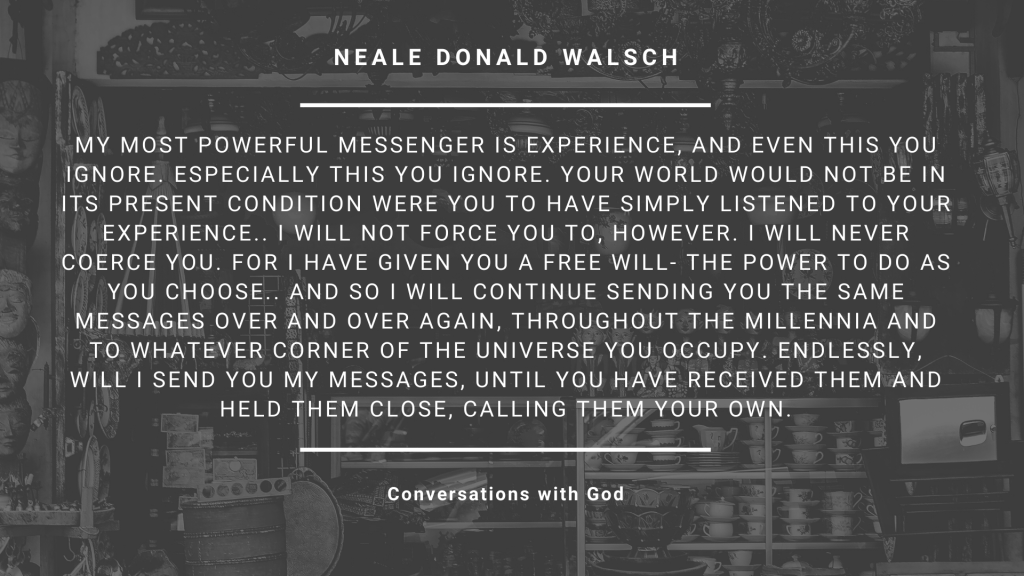
I have never set down a “right” or “wrong” or a “do” or a “don’t”. To do so would be to strip you completely of your greatest gift- the opportunity to do as you please and experience the results of that; the chance to create yourself anew in the image and likeness of Who You Really Are; the space to produce a reality of a higher and higher you, based on your grandest idea of what it is of which you are capable.
God’s answer, quoting from the book, p. 39
What if You are God?
You are LIMITLESS. You create and through you, God experiences. One would wonder what is this ‘God experiencing through his creation’? We believe that we are God’s creation, so how can we think that God’s creation would be any less? Walsch implies that we are Creators and we re-create.
Events are created by the combined consciousness of man. All of the world, co-creating together, produces these experiences. What each of you do individually, is move through them, deciding what, if anything, they mean to you and Who and What You Are in relationship to them.
Thus you create collectively, and individually, the life and times you are experiencing, for the soul purpose of evolving.
God’s answer. Conversations With God, p.37
We have come a long way and all of this has been our creation, with or without the help of God. This way God experiences through his creation’s recreation. It is like humans and AI, to make it simple. The message of this book revolves around the fact that we are limitless, our potential is far beyond we can even think. The book tries to make you question and think Who You Are. This phrase is often repeated. After all, this is what are hunt is all about. We create and we still try finding our purpose and under Who We Are.
The book has done a brilliant job in awakening the urge in me to create, to be the creator that I am already, create better and help others create better as well. Like many spirituality-centric books, this one also focuses on many aspects of spirituality, in a more Western way by quoting the western texts like Bible, and also every now and then the Eastern texts. I noticed, ultimately, I have got similar messages in different words and forms. It is indeed like the God speaking to me in different forms, we know the Universe does this. How different is the universe from God? How different are We from God?
-Pooja Ashokkumar, the creator and the Creator 😉
If you have already made up your mind to buy the book, here is a direct link for the same: https://amzn.to/3qrJAAL
I have always believed that the Universe has too many ways to communicate with us. It might not be too soon or too late but right on time. Out of many ways, one is through books. I am so convinced with this based on my own experience of stumbling upon a book and realizing how much I needed to read it. I tend to accidentally buy books that I don’t not really want to but something pushes me to buy and read them at the right-est time, in all honesty, one such book is My Gita by Devdutt Pattanaik. I cannot stress on how I am happy to have read it.
Before I start discussing about the book, I would like to acknowledge and shower my love on the author’s narrative. Every writer is different, has a unique story to present and connects with you differently. Devdutt Pattanaik stands out in terms of connecting quite accurately. Simple at the language, minimalist approach and makes the most complex concepts perceivable. A good writer or a storyteller is the one who enables you to visualize. Devdutt Pattanaik, throughout his narrative, presents you the picture. This keeps you engaged as a reader. He is any reader’s writer and by that I mean ANYONE can read and understand what he is trying to convey.
My Gita to the rescue
There are times when you are pensive and perplexed, almost in a dilemma about many things in life. You seek answers for so many questions that linger over your mind. I experienced this. Just when I thought I am lost without a beginning or an end, My Gita came to the rescue. The personification here comes from the feeling of almost having a conversation with someone more than a book. I was answered. Yes! I could relate to every alternate passage and verse. In a way, I was able to recollect similar experiences or those that made more sense after reading the book. I will be sharing a few quotes from the book to relate with my thoughts about it.
My Gita is Devdutt Pattanaik’s interpretation of Shri Bhagavad Gita which is the knowledge of the universe given to Arjuna (the seeker) by Lord Krishna (the giver) amidst the Mahabharata war. The book revolves around the Hindu paradigm but also around other religions, giving you an understanding of those too. A newbie would not really have to worry about not understanding something as every concept is well explained in the most comprehensible manner.
It connects the past with the present, thus making it more relatable for a contemporary. This also left me wondering about the accuracy and significance of the modern terms that we apply on the narratives of the past. While reading I realized that we look at the past, the times that we have not witnessed, with the present or modern magnifying glass and conclude on that basis. This might not do complete justice to the past. I realized how the world was different in each stage, thus, the possibility of needs and definitions of many things being different from what it is now. Simply, even the meaning of our identity differs. A lot might have not been the same as we see them today. A following quote from the book may explain what I mean here.
Karma may determine the circumstances of our life. But humans have the power to create their own identity by creating and claiming property, or kshetra. Society values people more as proprietors than as residents of the body, for property is visible and measurable. As a result, ‘mine’ becomes more important than ‘me’.
Devdutt Pattanaik, My Gita, 2015, p.183
Besides, My Gita is more psychological and philosophical in its narrative than just religious as it seems. I realized how religious notions are also not too different from concepts involved in these western terms- psychology and philosophy irrespective of different languages or explanations
It got me to the gradual realization that I was being led towards ‘self-actualization‘. I questioned myself, my thoughts, approach and attitude towards many things in life. It made me ponder upon those I had not thought about otherwise. It added on to my insights and broadened my ways. Many may disagree with his interpretation of the Gita but that is what My Gita focuses on, you may agree or disagree, you can be right or wrong, you are free to believe anything or nothing, after all,
Your reality is different from my reality because your body is different, your filters are different, your experiences are different, your knowledge is different.
Quoting from My Gita, 2015.
Lastly, I realized that I am a different person after I finished reading My Gita. I evolved with each reading. In the end, I started seeing things and understanding differently. It would not be an exaggeration to say that I did feel enlightened. Sharing this one last quote among a plethora of wise quotes from the book that changed me as a person.
My deha is different from yours. My hungers are different from yours. My assumptions are different from yours. My capabilities are different from yours. My experiences are different from yours. My expressions are different from yours.
I was born in an area of Mumbai that comprised of people belonging to different sects and had different faiths.
This area has a Mosque at the entrance, a Temple in the middle of it and a Church further inside, towards the way to my house.
Although I was born in a Hindu family, I was raised by my Christian neighbours and Muslim family next door.
I would visit the temple everyday with my Grandmother, attend the evening aarti (worship rituals) and relish on the prasadam (sacred food) and even tirtham (holy water) given by the Priest.
I would even visit the church, my neighbours would take me along (to be precise), attend the masses and had myself to the holy water be sprinkled upon by the Father.
I had also been taken to the Mosque once when I was burning in fever that lasted for days despite the medicines, until, the Imam (priest) prayed and tied a Taweez (charm) around my neck. My parents say that I recovered real soon.
I loved celebrating Diwali, burning crakers along with my friends. Our Christian and Muslim neighbours would lit lamps and candles, so that we could have fun for some time longer. They would not even mind when we threw colours at them during Holi and say “bura naa maano, Holi hai”.
I absolutely loved the Biryani cooked by my neighbour, Salma aunty, and also the huge platter with fruits, bhajiyas, sweets and other Ramzan delicacies that she would give us everyday during this holy month. I relished on the ever famous dessert Sheer khurma (vermicelli pudding) for the first time which was got by one of my Mother’s students. I used to wait for the sherbat (flavoured milk with nuts) that was distributed in every house by a group of Muslims during Muharram every year.
I loved the whole vibe during December month or Christmas season because the whole lane in front of our house would be lit with lightings and star shaped laterns. I would wait for the candies distributed by someone dressed as santa claus and would hang stockings in the window without fail. Enjoyed the porridge distributed during Lent Season and Easter delicacies too.
I don’t remember ever being hungry as a kid. I was in fact over fed and pampered by my neighbours and none of them ever made me feel different.
I heard stories of the Hindu Gods from my grandmother but I also heard stories of Jesus from other neighbours and some lessons from Salma aunty from the Quran.
I always felt that I was not alone a Hindu but also equally a Christian and a Muslim.
I have been a part of all the differences that we see today and thus I fail to differentiate. I have seen good and bad people. But I was never conditioned to see a good or bad Hindu, Muslim or Christian.
The whole world maybe working in a certain way. It might have changed in terms of its essence and ideals. There are ample reasons for it too. But what does not really convinces me is to see a group of people in a certain way, that we call prejudice. It is definitely the behaviour that is certainly good or bad. But behaviour of a particular number of people can never be the sole representation of the entire community or world.
Is it that we forget that we are all individuals despite the diverse identities we carry or are attached with? We all definitely want to be a part of the social identities given to us and even want to be good at it, but we are still individuals. Even if we are influenced and manipulated, it becomes our individual choice to do what we do. Individual choices lead to the doings, good or bad.
Most of us have been fortunate to have been among so many different types of people with different beliefs and identities. It is on us, individuals, how we want to see the “difference” that is pertaining and becoming more prominent with time. And we do know that every individual deserves love, if not then what are terms like equality, fraternity and others that are used otherwise are really for?
There is no way that we are pure or belong to only one identity. At last, there is only one question I would like us all to ask ourselves,
Review of one of the most enlightening Hindu mythological books.
“Myths may not satisfy the demands of rationality or science, but they contain profound wisdom – provided one believes they do and is willing to find out what they communicate.”
Mythology has always played a pivotal part in civilizations around the world since ages. The prehistoric cave paintings to other tangible monuments have left traces of mythology and this makes it easier for us to access and adhere different religions that prevailed. As Carl Jung, the famous Swiss psychiatrist and psychoanalyst, mentioned, “myth is a necessary aspect of the human psyche which needs to find meaning and order in a world which often presents itself as chaotic and meaningless”, there is significance of mythology even today in our lives, the only need is to interpret it right. Ramayana versus Mahabharata: My Playful Comparison by Devdutt Pattanaik, has some similar lessons to proffer, enhancing the importance of mythology and its relevance in the present times.
Book: Ramayana Versus Mahabharata: My Playful Comparison
Author: Devdutt Pattanaik
Published by: Rupa Publications India Pvt. Ltd, New Delhi
Devdutt Pattanaik is a well-known Indian author with expertise in the areas like mythology, ancient Indian scriptures, symbols and rituals and other stories or narratives. His other books include, Myth= Mythia: A Handbook of Hindu Mythology, Jaya: An Illustrated Retelling of the Mahabharata, Shikhandi: And Other Tales They Don’t Tell You, Shiva to Shankara: Giving Form to the Formless and many other that have incorporated Vedic knowledge generously. To get Saraswati out of the closet, as she belongs everywhere and has to flow everywhere and to make knowledge accessible, is his desire and aim. By Saraswati, he means ‘Knowledge’, as the Goddess Saraswati is associated with knowledge, Pattanaik uses the mythical name, while addressing it to everyone.
No society can exist without myth as it creates notions of right and wrong, good and bad, heaven and hell, rights and duties. Mythology tells people how they should see the world..different people will have their own mythology, re-framing old ones or creating new ones.
What makes the book ‘Ramayana versus Mahabharata: My Playful Comparison’ significant?
Time and again, Devdutt Pattanaik, the accomplished author has given some invaluable definitive works on the genre- mythology. Beginning with the external aspects and then to the internal, here are some points that escalates the significance of this particular book.
Distinct title and vibrant colour
Most of Devdutt Pattanaik’s books actually hold a very distinct title, that gives a clear idea about what is going to be inside unlike other ‘do not judge me by the cover‘ kind of books. As his concept revolves around mythology and mythical stories, the distinct nature of the title makes it easy for a reader to choose as to which part of mythology they want to read about. The title Ramayana versus Mahabharta: My Playful Comparison is no different. You know it is a comparative narrative of both epics. The colour of the cover is bright and vibrant red that catches the eye.
Devdutt Pattanaik’s illustrations speak many stories at once. They are precise and narrate a story in themselves. Every book consist his illustrations. Not only as an author does Pattanaik wins hearts but as an illustrator too. Each chapter has a related illustration which makes it more appealing and enhances your imagination while reading.
Introduction and interpretation of religion or Dharma
As a reader, you will be introduced to the context on which the book is based on with all possible elaboration of its meaning and real sense. There is no necessity for you to be well-versed in the genre mythology or to have read the original scriptures of the two epics Ramayana and Mahabharata before reading this comparative narrative. The book will suffice your quench of knowledge regarding religion or dharma and this term is often seen in most of the books by Devdutt Pattanaik, a constant reminder of what Dharma or religion is or could be.
This book unveils perspectives that will surprise you and leave you thinking, those that you would not have thought about otherwise. It touches upon all the aspects of religion, mainly Hinduism because of the genre and relates it with everyday life, irrespective of the reader being a Hindu. There are inferences of Buddhism, Jainism, and sometimes of Christianity and Islam as well, all that makes much more sense and highlights the commonality and differences with reasons.
Embracing all aspects- Man to Woman to Transgender and many other
One of the best attributes of Devdutt Pattanaik’s books are that even though each book stipulates one term or concept, yet speak from every side and corner, right from man to woman to transgender, to patriarchy and feminism. Ramayana versus Mahabharata is no different. It holds all the aspects hidden and evident both. If a chapter talks about men one side, there is a chapter dedicated to women and transgender too. This only enhances the importance of the book.
Humanism over theology
“Everybody dies- some suddenly, some slowly, some painfully, some peacefully. No one can escape death. The point is to make the most of life -enjoy it, celebrate it, learn from it, make sense of it, share it with fellow human beings so that when death finally comes, it will not be such a terrible thing.”
Devdutt Pattanaik constantly emphasizes on humanism through his interpretation of this comparative narrative. In the end, the conclusion you can draw out of all chapters will comprise of ‘what to learn from the? how and what you can relate to? how close this is example is to one of your life experiences? and how you can apply the lessons learnt here to be a good human yourself?’
After a lot of thinking, whether or not to write a review of this book or even after deciding to, what all should be present in this compilation or how much justice will my review do to this brilliant piece of work was my instant thought. It astonishes me as to how much an interpretation or perspective could be this precise, relevant and makes absolute sense in the world, allowing me to think or reason and to apply the lessons learnt through it.
You can find Ramayana versus Mahabharata: My Playful Comparison by Devdutt Pattanaik-
Life has come to a point where an emotion, the basic, has to be reminded and motivated about. We are on the search of those emotions that we feel are lost among the hustle and tussle of everyday life. Emotions are present in each one of us. Some inclining on the extreme side, while some on the mild or least side. When I look around the people around me, I think, I introspect, if they are truly happy. I ask myself, if I am happy. The ones reading this right now, ask yourself if you are happy? Happy about the job you do, about the people you are surrounded by, about the things you do, about the life you live? We are still trying to figure that out.
It is true that many of us are lagging behind the fast pacing world unable to cope up with and find a solution for it. This is continuously repressing us from being happy. Here are five ways that you can keep yourself happy.
Know your needs
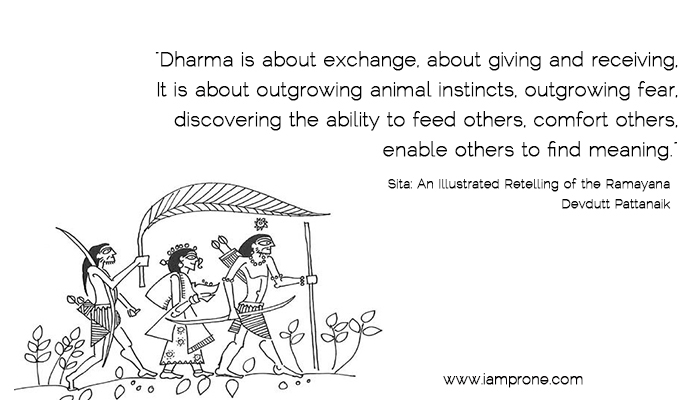
“After nourishment, shelter and companionship, stories are the thing we need most in the world.”
A lot of people fail to distinguish between needs and wants, this is one of the major cause of distress. Once you know what is your need and work to suffice it, you will be less distressed. Know what you need, what is your instant need and save the rest for later. This process will satisfy yourself which will unconsciously and consciously make you happy.
In a day, there are many good things that happen, that usually are ignored or goes unacknowledged by us. Keep a track of the good things that happen with you in a day and count on them. This will help you focus less on the negative and more on the positive side of your day ending up in a happy mood.
Start noticing the little things that you come across everyday. It is the little things that embrace big happiness. Notice and appreciate if someone smiles at you, if someone helps you, if someone appreciates your efforts. We may snub these little things, but these are the reasons that can make your day.
Stop the comparison
Remind yourself that you are good the way you are and doing better whatever you are doing! We often compare ourselves and our lives with others, this is a natural phenomenon but consciously you can remind yourself that you are doing good. The comparison is what makes you feel less and leaves you in a desperate state of owning things and a life that someone else owns. Remember, the grass is always greener on the other side. The mantra to be happy is to be happy with what you have and feel happy when others grow.
Achievement and success are two different things. You many not always need to achieve something to be successful but you can be successful without achieving big things. It is easy to be happy after realizing this. Achievement and success can differ individually too. For some, success might be money, growth, luxury and achieving other big things, while for some it might be just helping out someone in a day, making someone cross the road or show direction, or help in some task. Knowing what success and achieving means for you will help you in being happy.
There is no other mantra for being happy except for yourself, hard-work and time. When you know your needs, your thoughts and ideas, your caliber, your skills and when you incorporate all this with some hard-work and leave it on time, things will fall on its place. Time is a healer and assents with hard-work. This is the ultimate solution to be happy.
In the arid world,
where the heat waves and barren land
try holding me afar,
I am the cool breeze-
changing directions and
gusting around the corners.
I am the oasis surviving all along
that a survivor might find.
I am unaccustomed to the norms,
and to the world that pulls me down.






 Sapient Musings