life, philosophy, Religion

Raised by Religions

I was born in an area of Mumbai that comprised of people belonging to different sects and had different faiths.

This area has a Mosque at the entrance, a Temple in the middle of it and a Church further inside, towards the way to my house.

Although I was born in a Hindu family, I was raised by my Christian neighbours and Muslim family next door.

I would visit the temple everyday with my Grandmother, attend the evening aarti (worship rituals) and relish on the prasadam (sacred food) and even tirtham (holy water) given by the Priest.

I would even visit the church, my neighbours would take me along (to be precise), attend the masses and had myself to the holy water be sprinkled upon by the Father.

I had also been taken to the Mosque once when I was burning in fever that lasted for days despite the medicines, until, the Imam (priest) prayed and tied a Taweez (charm) around my neck. My parents say that I recovered real soon.

I loved celebrating Diwali, burning crakers along with my friends. Our Christian and Muslim neighbours would lit lamps and candles, so that we could have fun for some time longer. They would not even mind when we threw colours at them during Holi and say “bura naa maano, Holi hai”.

I absolutely loved the Biryani cooked by my neighbour, Salma aunty, and also the huge platter with fruits, bhajiyas, sweets and other Ramzan delicacies that she would give us everyday during this holy month. I relished on the ever famous dessert Sheer khurma (vermicelli pudding) for the first time which was got by one of my Mother’s students. I used to wait for the sherbat (flavoured milk with nuts) that was distributed in every house by a group of Muslims during Muharram every year.

I loved the whole vibe during December month or Christmas season because the whole lane in front of our house would be lit with lightings and star shaped laterns. I would wait for the candies distributed by someone dressed as santa claus and would hang stockings in the window without fail. Enjoyed the porridge distributed during Lent Season and Easter delicacies too.

I don’t remember ever being hungry as a kid. I was in fact over fed and pampered by my neighbours and none of them ever made me feel different.

I heard stories of the Hindu Gods from my grandmother but I also heard stories of Jesus from other neighbours and some lessons from Salma aunty from the Quran.

I always felt that I was not alone a Hindu but also equally a Christian and a Muslim.

I have been a part of all the differences that we see today and thus I fail to differentiate. I have seen good and bad people. But I was never conditioned to see a good or bad Hindu, Muslim or Christian.

The whole world maybe working in a certain way. It might have changed in terms of its essence and ideals. There are ample reasons for it too. But what does not really convinces me is to see a group of people in a certain way, that we call prejudice. It is definitely the behaviour that is certainly good or bad. But behaviour of a particular number of people can never be the sole representation of the entire community or world.

Is it that we forget that we are all individuals despite the diverse identities we carry or are attached with? We all definitely want to be a part of the social identities given to us and even want to be good at it, but we are still individuals. Even if we are influenced and manipulated, it becomes our individual choice to do what we do. Individual choices lead to the doings, good or bad.

Most of us have been fortunate to have been among so many different types of people with different beliefs and identities. It is on us, individuals, how we want to see the “difference” that is pertaining and becoming more prominent with time. And we do know that every individual deserves love, if not then what are terms like equality, fraternity and others that are used otherwise are really for?

There is no way that we are pure or belong to only one identity. At last, there is only one question I would like us all to ask ourselves,

what if we belonged to the other side?

Standard
life, philosophy, poem

The Cosmic Soul

What if your soul does not seek for the worldly things?

If it constantly seeks the abstract but is surrounded by concrete?

If your journey is limited on the outside but beyond limits?

If the peripheries are just set but it sees no boundary?

If attaining needs are just bodily but there is nothing for your soul’s awakening?

What if you realize, that your thirst is unfathomable, impossible to be quenched?

That your wound is far deep and deceptive, impossible to be healed?

That your soul is the only absolute amid the cosmic realm, it lives even if you don’t?

And that the questions you ask yourself are the answers that your soul seek?

-Pooja Ashokkumar

Standard
Assam, Crisis, India, Inspirational, life, Motivational, Mysery, Polity

National Resources under Natural Threat

All you need to know about the drowning Gateway of North-east India.

Assam, the Gateway of North-east India, the land of Red river and of the magnificent Blue hills.
The land of largest tea garden and of the fleecy silk ‘Eri’ and ‘Muga’.
The land with men in ‘Suria‘ or ‘Dhoti‘ and women in ‘Mekhela Chador’ or ‘Riha Mekhela’.
The land holding the legacy of Kamarupa and of the Ahoms, whom Assam derives its name from and the land that sees the ‘Bleeding Goddess’ as divine.
The land of “Dig-Boi” producing onshore natural gas and land of national parks dwelling ‘One-horned Rhino‘ along with numerous specie being worshiped the most

Recently, this pleasing land of the undemanding people has seen nature’s wrath but hope and succour of the people is still intact and unaffected. Although, it is not the first time that the State has witnessed something as devastating as this, it has only become more immune and stronger with each calamity’s stroke without any talking about their grievances.

“We have grown up watching the floods. My Grandmother recollects the time when they had lived on streets and the conditions have been this worse since then. It has become a routine for us; like other seasons- summer, winter and rainy, the floods have become a season too.”

– A resident of Assam.

What is happening in Assam?

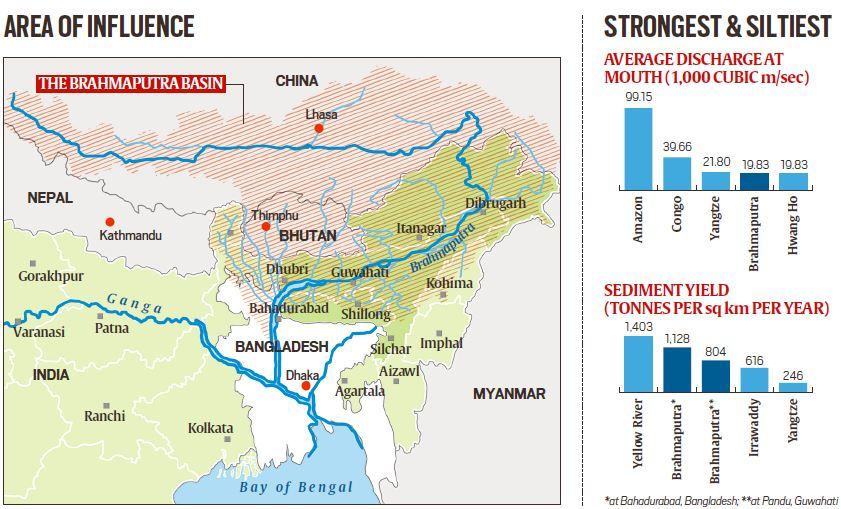
Overflowing of the rivers Brahmaputra, Barak and Jia Bhoreli has left the state into a catastrophe. Brahmaputra floods keep striking the state every now and then, but the sudden rise in the rivers since June 2019 has caused severe damage to the state. Assam receives excessive rainfall as it falls under the meteorological zone causing an increase in the water levels of the Brahmaputra and its tributaries that flows through the state.

Till 18th July, death toll touched 27 and increased, 4000 villages in 28 districts out of 33 of the state have been affected. 1000 houses damaged and over 16 lakh animals included livestock have been affected.

Assam State Disaster Management Authority. https://www.indiatoday.in/india/story/monsoon-misery-assam-annual-tryst-with-floods-1571473-2019-07-20

The Brahmaputra floods are not a new concept. It is a catastrophic flood event occurred across the Brahmaputra and its tributaries subsequently since 2012.

https://en.wikipedia.org/wiki/Brahmaputra_floods

The floods have severely damaged the embankments, roads, bridges, culverts and many other infrastructures of Assam and Barpeta district is the most devastated out of all others, followed by Nagaon, Goalpara, Morigaon and Hailakandi. The rising water level has affected Nematighat, Tezpur, Guwhati, Dhubri, Goalpara. Other areas affected include Dibrugarh, Kamrup, Cachar, Lakhimpur, Golaghat, Sonitpur, and Karimganj. The floods have affected 95% of Kaziranga National Park has with the increase in the toll of wild animals and some submerging in water, including the affects on anti-poaching camps of the national park. The Pobitora Wildlife Sanctuary in Morigaon district was also flooded. Floods in Assam has disastrously hit the agricultural lands too.

Why is Assam prone to floods?

Any area affected by some crisis has contribution of both natural and man-made factors. Assam already falls under the meteorological zone that receives excessive rainfall during monsoon. The region has occasionally witnessed even 500 mm of rainfall in a day.

The region receives rainfall ranging from 248 cm to 635 cm, rainfall of more than 40 mm in an hour is frequent and around 70 mm per hour is also not uncommon.

Brahmaputra Board, Ministry of Jal Shakti.
https://www.indiatoday.in/india/story/monsoon-misery-assam-annual-tryst-with-floods-1571473-2019-07-20

The rapidly overflowing rivers through the narrow valley where the Brahmaputra flows from, spread reaching the narrow strips which later affects the forest covers and farming areas in the low-lying areas around. Assam also possesses steep slopes that results into rivers cascading towards the plains. As the North-east region of India lies in a seismic zone, earthquakes and landslides are frequent which ends up in sedimentation that raises river beds. Other major factor is encroachment- the destruction of natural drainage like wetlands and water bodies has provoked the problem.

What can be or is being done for Assam floods?

Measures have been taken by the locals and the State Government through rescue operations and rehabilitation. People have been evacuated and accommodated to relief camps across the state. Major role being played by the National Disaster Response force and Khalsa Aid that has been distributing emergency supplies to flood-affected people in Assam and other flood affected areas earlier. Similarly, the State health department along with animal husbandry and veterinary are also addressing medical issues due to the floods.

How can you contribute?

Natural calamity is a phenomenon that we cannot control or stop. It will happen and it will stop too, but the amount of destruction it causes is transcendent. All we can do is take measures or precautions to be prepared or at least find ways to recover for the aftermath. As humans, we need to help other humans.

Assam has been suffering for a long time, the State has been recovering on its own and the Centre has taken the matter into consideration, although none have been able to successfully find a solution for the inevitable floods. As fellow countrymen and humans, it is our responsibility to provide aid to the state in all possible ways. An official account and website for relief funds have been spread among others. Below mentioned are the details for the same along with the official website of the Chief Minister of Assam attached, where you can donate.

Account-Holder’s Name: Chief Minister’s Relief Fund Assam
Bank: State Bank of India (SBI)
Account Number: 35969660230 (SBI), Secretariat Branch
IFSC: SBIN0010755
PAN: AAATC4667K

https://cm.assam.gov.in/relieffund.php

Some other ways to help the flood affected people

Paytm app- the mobile payment app can be used for making online monetary contribution to Assam Flood Relief. You can also contribute items like Rice, Dal, Biscuits, Sanitary napkins, clothes and other essentials to the authorities in Assam through mentioned details and link ahead.

Jhalukbari
Name: Debashish Rajkhowa
Address: H-10, Pragjyotish Nagar
Contact Number: 8876993579

Dharapur
Name: Robin Diksha Dhar
Address: Agrim Vista
Contact Number: 7002602010

Narangi Tinali
Name: Robin Ajay
Address: Indira Gandhi Computer Shakshrta Mission, Opposite of UCO Bank
Contact Number: 9085140567

More details in here : https://www.kaziranga-national-park.com/blog/assam-flood-information/

https://www.wti.org.in/tag/kaziranga-national-park/

Standard